
Calls are answered even when the team is out of the office
OMO can serve incoming and scheduled outgoing calls 24/7 — within the limits of defined work rules, availability of telephony and related systems.
Why OMO
The short answer
OMO’s advantage is not simply that “AI talks.” It combines continuous availability, a consistent workflow, actions performed in real systems, and complete evidence of what happened during every call.
Complete benefit map
OMO can serve incoming and scheduled outgoing calls 24/7 — within the limits of defined work rules, availability of telephony and related systems.
A voice agent can handle multiple calls at once within its allocated capacity. Growth is planned through configuration and infrastructure, not only through additional hiring.
Greetings, required questions, verification, change and completion are handled through the conversational process. The agent does not get tired, does not forget mandatory questions and does not arbitrarily change the business rules.
OMO checks a calendar, creates a booking, initiates a call, stores a rating, records a lead outcome, or routes the caller.
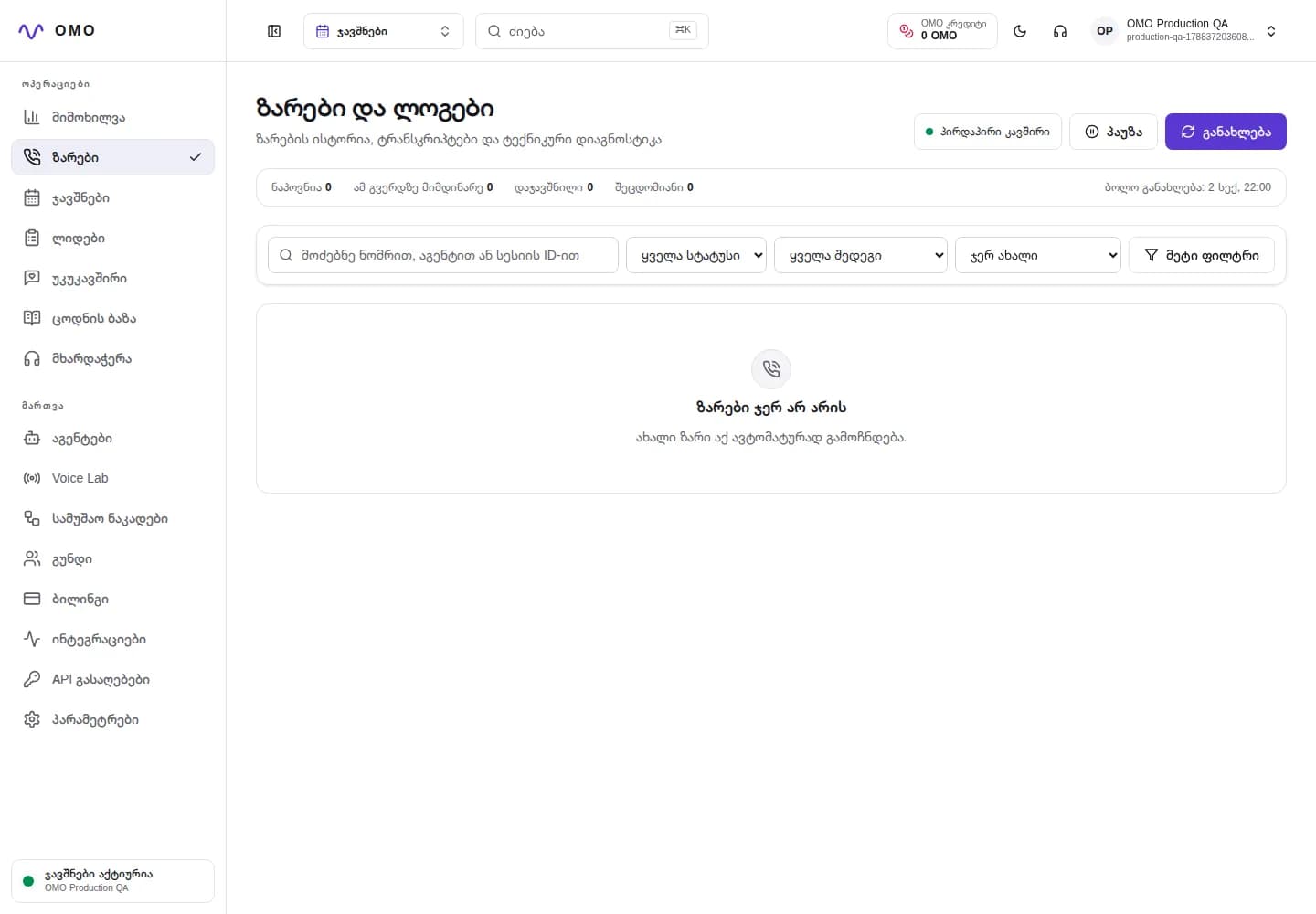
With recording enabled, an operator sees the audio, Georgian transcript, workflow stages, timing, latency, technical events, errors, and final action in one place.
A single word does not become a decision. Name, number, date, time, consent and change request are processed by the context where the conversation is taking place.
An unclear phrase or background sound must not become a booking, a data change, or another critical action. OMO asks a short clarifying question or follows predefined safe behavior.
AI handles the repeatable workflow, while emotional, unusual, high-risk, or clearly uncertain cases can be transferred to a person using an agreed rule.
Each SIP number can have its own agent, voice, workflow, business hours, and product: booking, outbound sales, surveys, or conversational IVR.
One shared OMO balance is used across active products. Outbound calls consume credits according to connected voice time; unanswered calls are not treated as connected calls.
Reliability from the ground up
Reliable voice AI does not mean infallibility. It means that the system does not hide the uncertainty, verifies the critical fact in the real source and performs the action in a clear manner.
The agent interprets the request, but every offered time must come from the connected calendar’s current availability.
A confirmed field changes only when the caller clearly requests that specific correction.
If an answer is insufficient, the agent clarifies it, repeats one short question or follows a safe fallback instead of inventing a fact.
The panel shows the transcript, completed stage, requested action and response returned by the connected system.
Evaluation checklist
Do you see the actual results of all calls, not just the transcript?
Where does the doctor, price, time, or other fact come from—from a real source or from model memory?
What happens when the voice is unclear, the integration doesn't respond, or the user changes their mind?
Can the operator view audio, stages, delay and error in one space?
How does a complex case transfer to a person and does it preserve the collected context?
Scenarios in the product
A confirmed visit and calendar entry—or an understandable reason why the action failed—appears in the panel.
Real booking process · Calendar · Audio · Transcript · EventsThe team receives more than a recording: each call is classified as interested, callback requested, declined or unreachable.
Actual Campaign Process · Contacts · Attempts · Complete Callback Cycle · ResultsThe response is linked to a specific campaign and call, and the team can see causes and trends.
Actual survey process · Rating · Comment · Status · Audit trailThe user gets to the process he needs without having to listen to long button menus.
Real Demo Route · LiveKit SIP · Pipecat Process · Final DirectionDirect answers
A clear explanation of OMO’s capabilities, boundaries, and control model.
Yes. The agent does not depend on human shifts and can receive or place scheduled calls 24/7. Actual availability also depends on the SIP provider, connected systems and configured working rules. Any interruption remains visible in the panel.
Critical actions never rely on free text alone. Calendar time, phone format, flow stage and final confirmation are validated separately. If meaning is unclear, OMO clarifies it or follows a safe fallback instead of inventing a doctor, time, patient or outcome.
Not in all cases. OMO is better at repeatable, rule-based and measurable processes. A person is better able to deal with difficult emotions, unusual exceptions and responsible decisions. Therefore, the most reliable model is a hybrid: AI performs the routine, the human takes the difficult case.
Each session shows the status, result, audio - if recording is enabled - Georgian transcript, conversation stages, delay, events and errors. Therefore, the assessment is not based solely on what the agent says; It is possible to compare the conversation and the actual action.
Concurrency is not a single fixed public number. It depends on the allocated computing power, SIP channels, model limits and the workload of the conversation process. The required volume is pre-measured by simulation, and the working configuration is planned according to the actual peak load.
Reliability is built on evidence: Georgian scenarios, Tbilisi time, real calendar and system integrations, verified conversation process, required consent, safe backup behavior and audit trail of each call. OMO does not claim 100% detection; It manages uncertainty and provides visibility to the operator.
Tell us how your calls work today, and we will map the first voice workflow around your real requirements.